My research, main takeaways...
for now
Lessons in Academic-Community Collaborations: Working with Young People
Organisational, interpersonal and methodological challenges
Challenge: Overlooking educational biases
Challenge: time, money, resources
Challenge: not scheduling reflection moments right before and right after
Challenge: Recruitment
Challenge: power dynamics in the academic team
Challenge: getting youth to open up
Collaborate with youth workers (reimburse them so that they can invest in the project)
Facilitators
Work on build relationships of trust and mutual learning
Accept inevitability of power dynamics with youth… they have power over you in some regards but you also have power over them
Push to establish supportive infrastructures like trainings, community boards, better open science and outreach at the university
Communicate clearly with the team
Let young people warm up, prime them to boost their confidence and creativity
Context dependent materials, there’s a right what and a right when, and less is always more
Participatory Design of an AI based Mental Health Chatbot with Youth
01
Youth (aged 13-23) are open to using apps for mental healthcare
02
Think apps can help with human connection, self-development, and education as potential functions
03
Prioritize personalisation wit h extensive customisation settings and clear privacy policies
04
They would prefer not to use chatbots for mental healthcare
05
Think chatbots are fake and lack emotional intelligence
06
See chatbots as providers of information, favouring simple language and short texts
What have I been up to?
Humane Conversations on Youth and AI
Panel discussion hosted by UvA. We discussed what benefit AI can provide to youth; what harmful consequences could appear; how to navigate questions of consent; what policies should be in place…
- January 2026
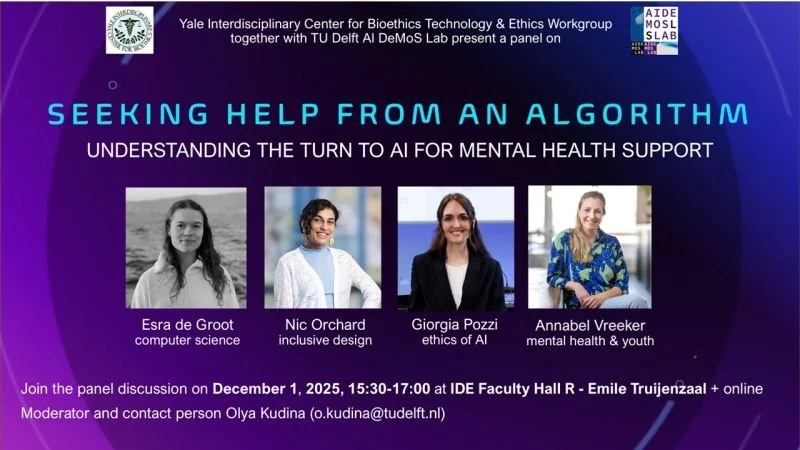
Seeking Help from an Algorithm: Understanding the Turn to AI for Mental Health Support
Participated in a panel discussion organized as a collaboration between the TU Delft | AI DeMoS Lab and the Technology & Ethics Workgroup at the Yale University Interdisciplinary Center for Bioethics.
My proposition: "Involving stakeholders in the initial developmental stages of AI-based apps is by far more important than the final stages."
-December 2025
AI chatbots for promoting healthy habits: Legal, ethical, and societal considerations.
Digital Health (2025). Kolfschooten H., Gonçalves J., Nic Orchard., Caroline F.
-November 2025
Co-authored a Paper for Digital Health
Co-authored a Paper for Medical Informatics and Decision Making
M. Task-Technology Fit of Artificial Intelligence-based clinical decision support systems - a review of qualitative studies.
BMC Medical Informatics and Decision Making (2025). Parsons C.S., Zuiderwijk-van Eijk A.M.G., Orchard N.A., Oosterhoff J.H.F., de Reuver M
-October 2025
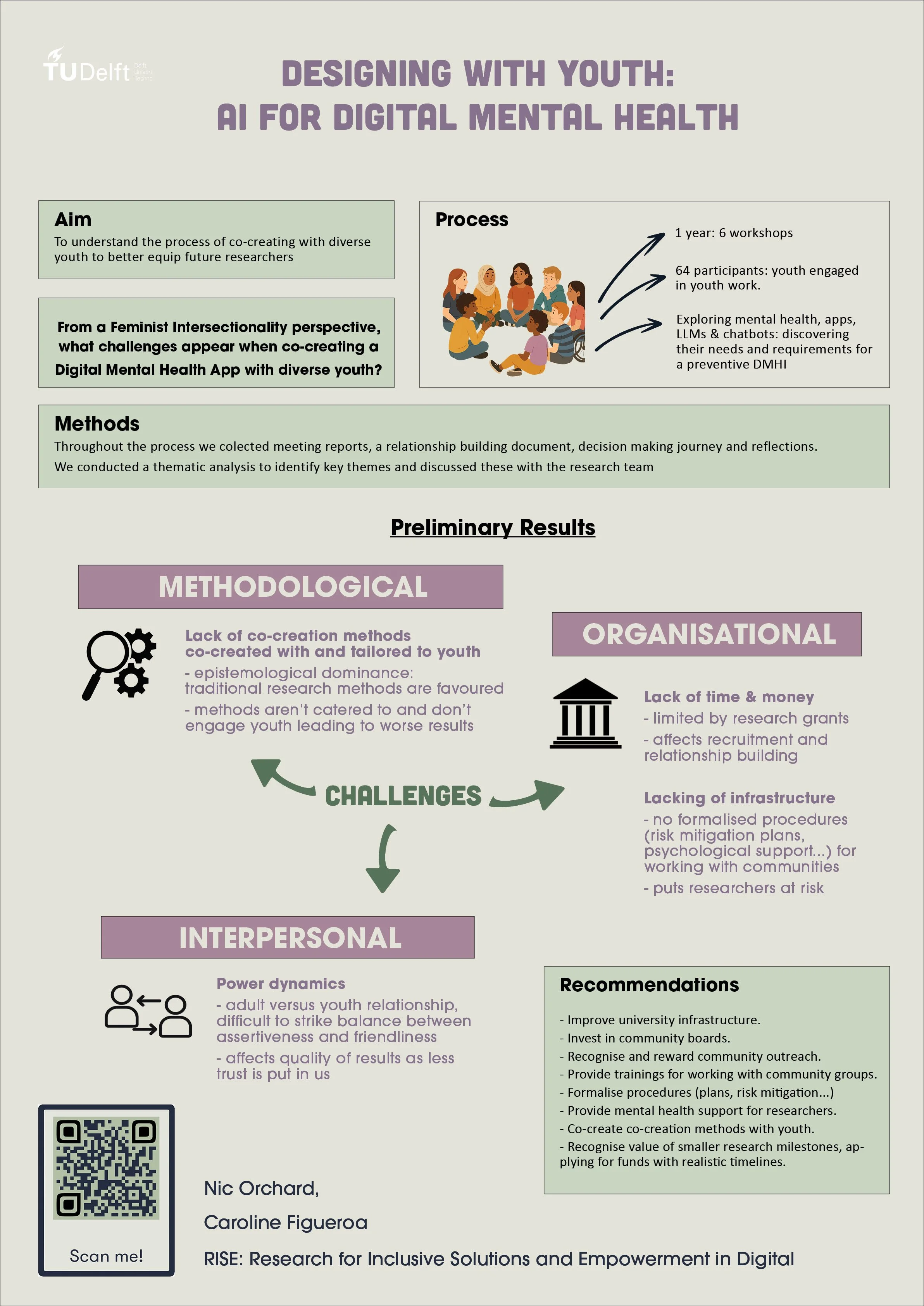
I presented a poster at an AI for mental health symposium. The poster included the preliminary results of the process paper I was writing.
From a Feminist Intersectionality perspective, what challenges appear when co-creating a Digital Mental Health App with diverse youth? Organisational: lack of time, money and adequate infrastructure; methodological: lack of co-creation methods co-created and tailored to youth; interpersonal: power dynamics.
-June 2025
Poster on Designing With Youth
Redesigning co-creation of AI for mental health with young people
I presented at the 2025 Supporting Healthy by Technology Conference in Twente. The focus was to show how to apply an intersectional feminist framework for meaningful stakeholder engagement: providing tips and recommendations for meaningful engagement.
-January 2025
Redesigning co-creation of AI for mental health with young people
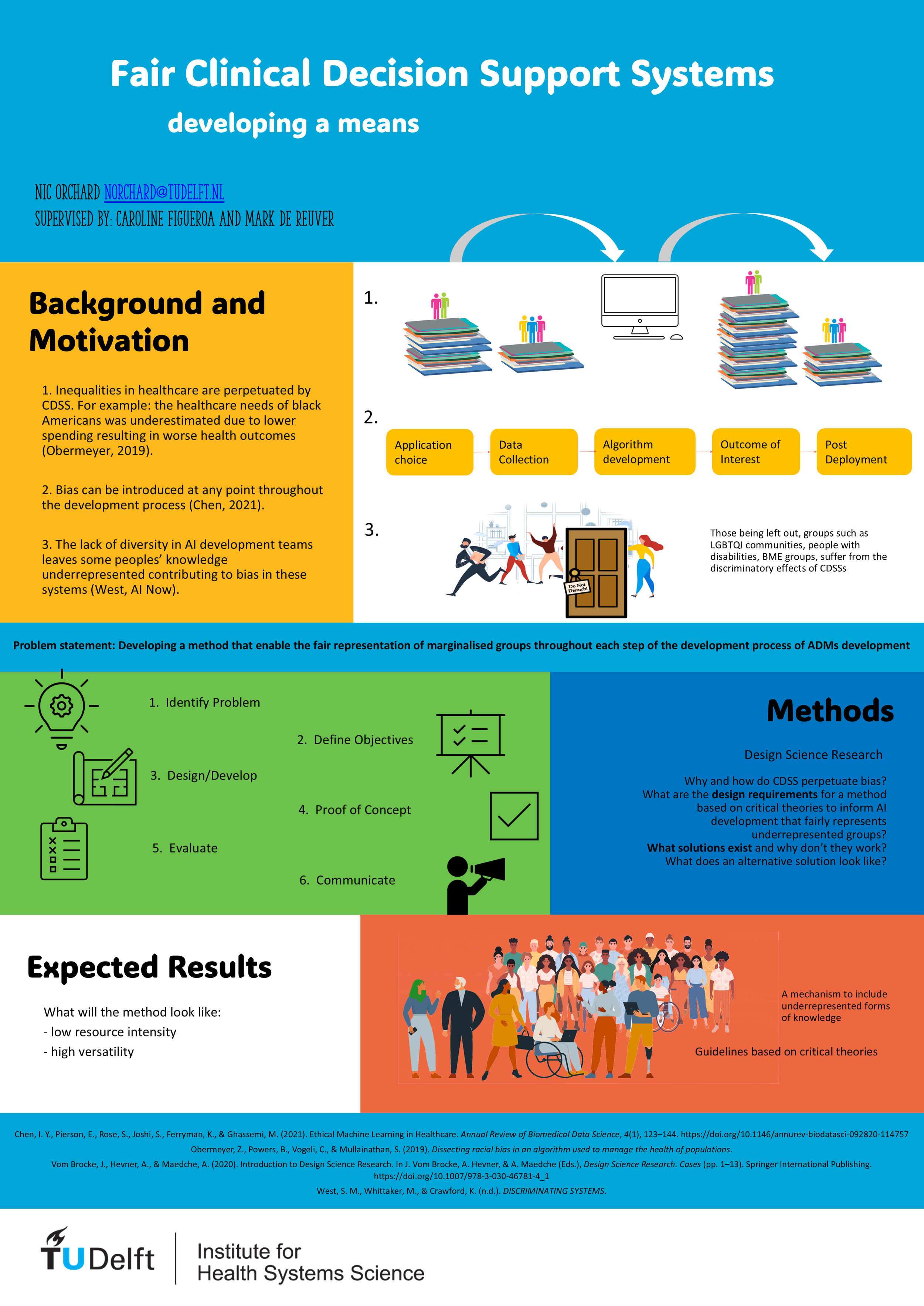
I made this poster during the first months of my PhD to show my research interests and define the goal of my PhD. The aim was to provide an alternative to mainstream ethical guidelines which focuses on the redistribution of power during the development process of AI.
-March 2023